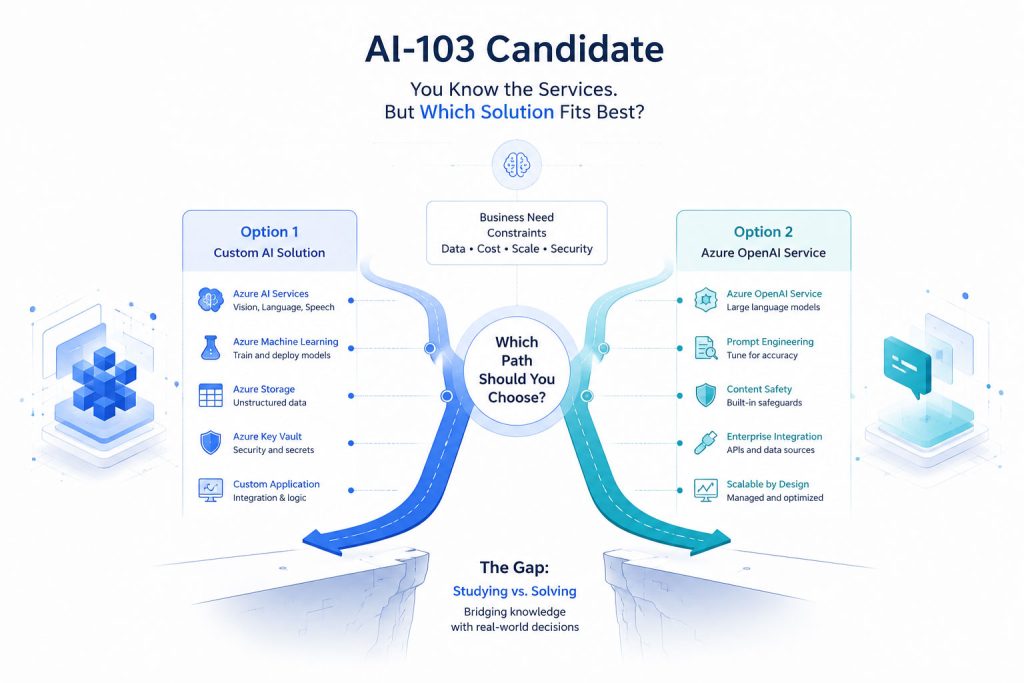
You finish a Microsoft Learn module and recognize the services in the next practice question. Then two answers look right. That moment matters more than your completion percentage, because AI-103 is testing what you can decide—not simply what you have seen.
The Strange Part About Preparing for AI-103
There is an uncomfortable stage in AI-103 preparation where studying starts to feel productive while readiness remains difficult to measure.
You have worked through Microsoft Learn. Microsoft Foundry no longer looks unfamiliar. Terms such as RAG, agents, Azure AI Search, multimodal models, Content Understanding, and SDKs have stopped sounding exotic. You may even be able to explain what each service does without checking the documentation.
Then a scenario changes one requirement, and suddenly the answer is less obvious.
That distinction matters because the current AI-103 blueprint is not simply a catalogue of Azure AI products. Microsoft describes the target candidate as an Azure AI engineer who builds, manages, and deploys AI solutions and agents using Microsoft Foundry, with Python development experience and familiarity with general AI, generative AI, and Azure services. The largest measured area is generative AI and agentic solutions at 30–35%, followed by planning and managing Azure AI solutions at 25–30%.
So the useful question changes.
Not, “Have I studied this service?”
Instead: “Can I choose this service when the scenario gives me competing requirements?”
That is a much less comfortable question.
It is also a much better readiness test.
Microsoft Learn Can Get You Started. It Cannot Tell You When You’re Ready.
Microsoft Learn deserves a fair reading here. Microsoft explicitly recommends training and hands-on experience before taking AI-103, and its study guide provides the skills measured, documentation, training resources, and supporting material.
That makes Microsoft Learn a strong foundation. It does not make it a personal readiness report.
A completion percentage can tell you how much material you have worked through. It cannot tell you whether you can distinguish two technically valid solutions when a scenario introduces cost, security, retrieval, latency, model, governance, or implementation constraints.
Microsoft’s own blueprint makes this distinction visible. The exam expects candidates to choose models and Foundry services, select retrieval and indexing methods, configure security, manage quotas and scaling, implement RAG, evaluate model quality and safety, build agents with tools and memory, and work with multimodal and information-extraction workflows.
Those are decisions.Reading about each capability is preparation for the decision. It is not evidence that you can reliably make it.
There is another practical issue in August 2026: Microsoft’s certification page still says the Practice Assessment is not currently available. Microsoft says practice assessments are generally available after an exam is out of beta and generally available, usually within eight weeks.
That leaves candidates with an unusually awkward question: how do you measure readiness when the official practice assessment is not yet available?
That is where the quality of your practice work starts to matter.
The Gap Shows Up When Two Answers Look Right
Consider the difference between recognizing Document Intelligence and Content Understanding and actually deciding which approach better fits a requirement.
A candidate may know that document processing can involve OCR, layout analysis, extraction, multimodal processing, and structured output. Microsoft’s current AI-103 guide specifically includes extracting information from documents and using Content Understanding to produce clean, grounded representations for agents and RAG.
But imagine the question does not ask, “What does Content Understanding do?”
Instead, it describes a workflow.
The input might contain documents with text, images, and layout. The application may need structured information downstream. Perhaps that information will be consumed by an agent. Perhaps the requirement emphasizes grounded representations rather than simply extracting text.
Now the question is no longer about remembering a product description.
It is about decision boundaries.
What is the input? What output is required? Does layout matter? Is the task fundamentally extraction, retrieval, multimodal understanding, or some combination? What will consume the resulting data?
This is why service familiarity can be deceptive. You can know both answers and still choose incorrectly because you have not learned the boundary that separates them.
The same problem appears elsewhere in the blueprint. Azure AI Search is not simply something to recognize. Candidates may need to reason about retrieval, indexing, semantic search, hybrid search, vector search, enrichment, and grounding. Agents are not simply a feature to define; their design can involve tools, retrieval, memory, function calling, safeguards, monitoring, and orchestration.
The exam does not become easier because you can describe each component separately.
The real test is whether you can assemble the right combination when the requirements change.
Python Questions Change the Feeling of the Exam
Python deserves attention for a different reason.
Microsoft explicitly says AI-103 candidates should have experience developing applications with Python. That does not mean the certification suddenly becomes a general-purpose Python programming exam. It does mean that someone who cannot comfortably read a small SDK example may be starting from a weaker position than someone who can follow what the application is doing.
Recent candidate reports make this worth checking rather than assuming.
One candidate who reported passing AI-103 in June described Python SDK code-completion and JSON-schema questions as part of the exam experience. Another August report described Python questions as an area where documentation was not especially quick to consult during the exam, while noting that prior Python experience helped with the logic. These are candidate-reported experiences, not Microsoft’s official question specification, so they should not be treated as guarantees about what every candidate will see.
The practical implication is narrower.
Can you read enough Python to understand what an Azure AI application is actually doing?
Can you identify what object is being created, what parameter is being supplied, what a method is returning, or how a JSON structure is being used?
If not, another hour of watching a service overview may not close that particular gap.
A short code example might.
That is a different kind of preparation because you are testing interpretation rather than recognition.
AI-103 Is Wider Than the Foundry Headline Suggests
The current AI-103 study guide is clearly centered on modern generative and agentic development, but the rest of the blueprint has not disappeared.
Computer vision represents 10–15% of the measured skills. Text analysis and information extraction each represent another 10–15%. The blueprint includes image and video generation, multimodal understanding, text analysis, retrieval and grounding pipelines, document extraction, security, monitoring, responsible AI, and infrastructure decisions.
Recent candidate discussions reinforce the need to verify the edges of your preparation.
An August 2026 candidate who reported passing AI-103 said the exam included vision and several Entra ID and security questions that were not covered in the candidate’s course. Another recent report mentioned vision, video generation, and Python as areas that deserved additional attention. Again, these are individual reports, not an official exam guarantee.
That distinction is important.
You should not turn Reddit into a second exam blueprint.
But candidate reports can reveal something Microsoft documentation cannot: where actual learners felt their preparation assumptions broke down.
That makes them useful as signals, not specifications.
The same principle applies if you are coming from AI-102. Previous Azure AI knowledge can still help, but it should not be treated as a substitute for checking the current AI-103 objectives. AI-103’s current blueprint places substantial weight on Foundry, generative AI, agents, RAG, orchestration, SDK integration, and related application development.
The Question I Would Ask Before Booking the Exam
I would not start with the number of hours you have studied.
I would not start with the percentage of Microsoft Learn modules you completed.
I would not even start with your practice-test score.
I would ask one thing:
Can you explain why the correct answer is better than the other plausible answers?
That sounds simple, but it changes how you review every question.
Suppose you choose Azure AI Search for a retrieval scenario. Fine. Why?
Was it because the requirement involved search and Azure AI Search is the service you remembered?
Or did you identify the need for a particular retrieval pattern, grounding workflow, indexing approach, or downstream agent integration?
Now change the scenario.
What if the data format changes? What if the requirement adds multimodal content? What if security changes? What if the application needs structured extraction instead of retrieval? What if cost or latency becomes the constraint?
If your reasoning survives those changes, you are building something closer to exam readiness.
If it collapses as soon as the wording changes, your answer may have been correct without your preparation being complete.
That is why a question should sometimes take longer to review than to answer.
The useful part is not simply knowing whether you selected A, B, C, or D.
The useful part is discovering which requirement eliminated the alternatives.
A Practice Score Is Useful. The Reason Behind the Score Is More Useful.
A practice score is still valuable. It gives you a number, and numbers can expose patterns that confidence tends to hide.
But the number alone is a weak diagnosis.
Consider these situations:
| What keeps going wrong | What it may reveal |
| Two plausible services keep competing | Decision-boundary problem |
| You understand the concept but miss the requirement | Scenario-reading problem |
| SDK or JSON questions slow you down | Code-interpretation gap |
| Isolated topics feel easy but mixed scenarios do not | Integration gap |
| Your score is high but your reasoning feels uncertain | Confidence may be ahead of readiness |
This is where AI-103 practice questions can become genuinely useful.
Recent candidate discussions show why. One July candidate described spending the final preparation period working heavily through practice questions and focusing on understanding the logic behind them. Another recent candidate specifically asked the community for high-quality AI-103 practice exams because the certification ecosystem is still relatively young.
The point is not that practice questions replace Microsoft Learn.
They should not.
The better relationship is almost the opposite: official material gives you the technical foundation; practice exposes where your judgment does not yet behave consistently.
If you are at the stage where you want to test readiness rather than collect another study resource, an updated AI-103 practice set from GeekCert can be considered as a diagnostic resource. The useful criterion is not the number of questions. It is whether the explanations help you understand why one choice fits the scenario better than another.
That distinction should also influence what you buy.
Look for material that reflects the current AI-103 objectives, uses scenario-based reasoning, explains service-selection decisions, includes relevant code or SDK interpretation, and helps identify weak areas rather than simply displaying a percentage.
Be cautious with any provider claiming guaranteed success, exact exam questions, or access to real exam content without credible evidence. Those claims are not a substitute for trustworthy preparation.
That distinction should also influence what you buy.
Look for material that reflects the current AI-103 objectives, uses scenario-based reasoning, explains service-selection decisions, includes relevant code or SDK interpretation, and helps identify weak areas rather than simply displaying a percentage.
What Readiness Actually Looks Like
Readiness is less dramatic than people sometimes expect.
It may simply mean that a new scenario no longer forces you to search your memory for the exact sentence you once read in Microsoft Learn.
You read the requirement first.
You identify what the application must accomplish.
You notice the constraint.
Then you eliminate solutions that technically work but do not fit the requirement as well.
That process is repeatable.
It is also much closer to the role Microsoft describes for AI-103: building, managing, and deploying AI applications and agents rather than merely identifying Azure product names.
A candidate who can do that consistently may be ready even if they cannot remember every documentation detail.
A candidate who has completed every learning module but still chooses based primarily on recognition may have more work to do.
That is not a criticism of studying.
It is simply a better definition of what studying is supposed to produce.
Before You Schedule AI-103
There is a particular moment in certification preparation when adding another course feels safer than testing yourself.
Sometimes another course is exactly what you need.
Sometimes it is just another way to postpone the uncomfortable measurement.
Before scheduling Microsoft AI-103, take a representative set of scenario questions and review the reasoning behind every answer you were unsure about. Separate mistakes caused by missing knowledge from mistakes caused by misreading requirements. Then look for patterns: service selection, retrieval, agents, Python, security, vision, information extraction, or mixed scenarios.
The current Microsoft study guide should remain your reference point because it defines the measured skills and is updated over time. Microsoft also provides an exam sandbox so candidates can become familiar with the exam environment and question types.
Use candidate reports differently.
They can tell you what other people encountered, what surprised them, and where their preparation felt incomplete. They cannot tell you exactly what your exam will contain.
That distinction keeps preparation grounded.
You studied it.
You recognized it.
Then two answers looked plausible.
That uncomfortable moment is not evidence that your studying failed. It may be the first useful evidence you have that your preparation needs to move from familiarity toward judgment.
And that is the question worth answering before exam day:
If the wording changed, would you still know what to choose?
That is a much better readiness test than another completed module.